Call for abstracts
Researchers, academics, industry experts, policymakers and practitioners: submit an abstract to present at MJVC 2026 in Hiroshima.
Conference themeAcademia, Industry & Society: Towards Co-Creating a Sustainable Future
Up to 250 words, through the online form. Use the abstract template.
Key dates
- Online abstract submission opens
- Proceedings paper submission opens
- Abstract submission deadlineOriginally
31 July 2026 - Notification of abstract acceptance
- Proceedings paper submission deadline
Who should submit
The Malaysia–Japan Visionaries Conference (MJVC) 2026 invites researchers, academics, industry experts, policymakers, and practitioners from Malaysia, Japan, and across the globe to submit original research abstracts for presentation at the conference. MJVC 2026 serves as a strategic platform to strengthen Malaysia–Japan collaboration, promote interdisciplinary exchange, and showcase visionary research addressing global challenges, technological advancement, societal transformation, and sustainable development.
Abstract guidelines
- Abstracts must describe original and unpublished research.
- Length: maximum 250 words.
- Abstracts should clearly outline the research objectives, methodology, key findings, and significance.
- Interdisciplinary research and Malaysia–Japan collaborative studies are highly encouraged.
- Accepted abstracts will be considered for oral or poster presentations.
Submission categories
Focus session chairs and details11 categories, 93 topics.
General sessions
Science & Technology
- Biology & Biotechnology
- Food Science & Functional Foods
- Chemistry & Materials
- Environmental & Climate Science
- AI, Data Science & Modelling
- Physics & Instrumentation
- Agriculture
Social Sciences & Humanities
- Communication & Media
- Sociology, Anthropology & Cultural Studies
- Psychology & Behaviour
- Education & Pedagogy
- History & Philosophy
- Language & Literature
- Politics & Governance
- Arts & Creative Industries
- Heritage & Tourism
Law, Economy & Business
- Business & Management
- Economics & Finance
- Entrepreneurship
- Corporate & IP Law
- Public Policy
- Marketing & Consumer Studies
Engineering & Energy
- Electrical & Electronics
- Chemical & Process
- Civil & Urban Engineering
- Automation & Robotics
- Materials & Manufacturing
- Energy & Infrastructure
- Automotive, Aerospace, Mechanical & Mechatronics
Health & Medicine
- Public Health & Health Systems
- Clinical Medicine & Diagnostics
- Nutrition & Dietetics
- Biomedical Science
- Pharmacy & Drug Development
- Nursing & Rehabilitation
- Mental Health & Counselling
- Traditional & Integrative Medicine
Cross-Disciplinary & Emerging Areas
- Peace & Global Security
- Sustainability & Circular Economy
- AI, Ethics & Society
- Disaster Risk Reduction & Resilience
- Science Communication & Public Engagement
- Innovation & Technology Transfer
- Climate–Health Nexus
- Sport Science
Focus sessions
Integrated Solid-State Circuits and Systems: From Devices to Intelligence
- Analog, digital, & mixed signal circuits, architecture, & systems
- Data converters & memory
- Sensors, MEMS, & bioelectronics
- RF circuits and wireless system
- Power management, power delivery, and control circuit
- Emerging & novel IC, system, and device
- High-performance computing for AI
- Nonlinear systems & circuit theory
- Advance packaging & chiplet
- Beyond CMOS: Nanoelectronics & heterogeneous
Biomonotsukuri (バイオものづくり): Sustainable Bio-Based Manufacturing and Bioremediation for a Circular Society
- Bio-based manufacturing technologies (bioprocessing)
- Carbon-neutral and sustainable bioproduction
- Bioremediation and environmental biotechnology
- Metabolic engineering for microbial production
- Protein engineering for sustainable development
- Microbial functional characterization
- Biopolymer synthesis
- Plastic degradation and recycling
EnergiMirai (エネルギー未来): AI-Driven Intelligent Energy Systems for a Malaysia–Japan Sustainable Future
- Smart Energy Cities: Reimagining Urban Infrastructure through AI Innovation
- Energy-Efficient Architecture: Designing Smart, Low-Carbon Buildings with AI
- Clean Energy Maximization: Enhancing Hydropower & Wind Efficiency via AI
- Electric Energy Mobility: Optimizing EV Charging Networks through AI
- Energy Storage Frontiers: AI-Accelerated Discovery for Next-Gen Battery Chemistry
- Resilient Energy Grids: AI-Powered Predictive Maintenance for Stable Power Supply
- Decarbonized Energy Industry: AI Applications in Carbon Capture and Storage (CCS)
- Energy Management Systems: Advanced AI Optimization for Carbon-Minimal Power
- Hydrogen Technologies: Optimizing Hydrogen Production and Storage through AI
- Bioenergy: Enhancing Bioenergy Yields and Waste-to-Energy Conversion via AI
Polylogues Across Culture, Heritage and Society
- Visual and Performing Arts
- Language, Literature, Translation and Cross-Cultural Communication
- Ritual, Religion and Cultural Traditions
- Education and School Curriculum
- Peacebuilding and Conflict Resolution
- Sports and Youth Development
- Food Diversity and Culinary Heritage
- Tourism and Cultural Heritage Promotion
- Governance and Public Institutions
- Technology, Innovation and National Development
Mirai-Build (未来ビルド): Digital Twins and BIM for Smart, Sustainable, and Resilient Built Environment
- BIM, Reality Capturing, and Digital Twins for the Built Environment
- Smart, Sustainable and Resilient Built Environment
- Artificial Intelligence for the Built Environment
- Robotics & Automation for the Built Environment
- Construction 4.0 & Project Management
- Circular Economy in Construction and Built Environment
- Predictive Facility Management
- Next-Gen Construction Project Economics
- Health and Safety Technologies for the Built Environment
- Technology-Enhanced Built Environment Education and Training
Previous MJVC proceedings were published by Springer Nature: Malaysia–Japan Visionaries Conference 2024 Proceedings (2024).
MJVC 2024 Proceedings on SpringerLink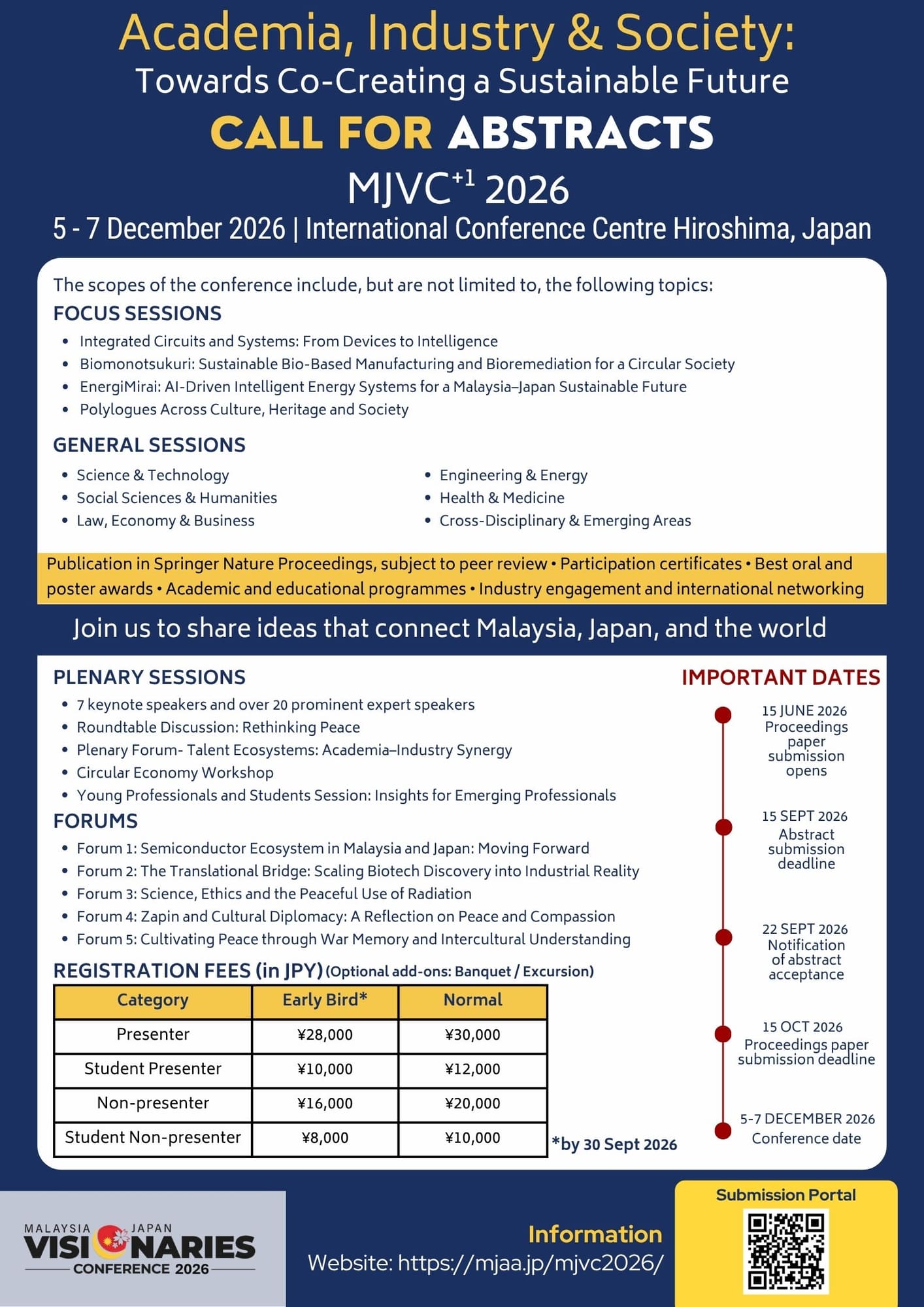 The call as a posterOpen the full-size poster to share or print
We look forward to welcoming you to Hiroshima for MJVC 2026.